GPL Legal Framework helps teams distribute, modify, and publish software with clear rules, reduced legal risk, and stronger internal discipline across product, engineering, and release management.
GPL Legal Framework begins with a simple idea: if a company distributes a program under the GNU GPL, it must preserve the users’ freedom to copy, modify, and redistribute that software. The official license text says the GPL is meant to protect those freedoms, including access to source code when copies are conveyed.
For a business, that means the policy is not just a legal artifact in a folder. GPL Legal Framework should shape how teams think about packaging, release notes, source availability, and downstream rights. A company that treats the license as part of product operations usually has fewer surprises later.
The practical lesson is that GPL Legal Framework is a governance system, not a checkbox. It helps a team know when a distribution event creates obligations, when the source must travel with the binary, and when internal use stays internal. That is why compliance teams should read the license as a workflow document rather than as a formality.
Why leadership should treat it as strategy
GPL Legal Framework belongs in planning meetings because licensing decisions can shape how a product is shipped, supported, and monetized. The FSF’s guidance emphasizes that the GPL is meant to keep released improvements free software, which means a leadership team needs to understand the business consequences before launch.
That is where GPL Corporate Strategy becomes useful as a way of thinking. When legal review happens early, product managers can choose architecture, release channels, and third-party components with a clearer picture of risk. GPL Legal Framework should therefore sit beside security review, procurement review, and brand review instead of being left until the end.
The human side matters too. Engineers work better when the rules are clear, and executives make better decisions when they know what the compliance boundary looks like. GPL Legal Framework gives both groups a shared reference point, which lowers confusion and helps the company move faster with fewer reversals.
Internal use is different from distribution

One of the most useful facts in GPL Legal Framework is that private modifications can stay private. The GNU FAQ says a company may modify a GPL-covered program and use it internally without ever releasing it outside the organization. The obligation changes when the modified version is released to others.
That distinction matters for compliance teams because not every code change creates public obligations. GPL Legal Framework separates internal experimentation from outward distribution, so a product team can test, adapt, and validate software before deciding whether it will be conveyed. Once the company crosses that line, the source-sharing duties come into play.
For managers, the lesson is simple: document the moment of release. GPL Legal Framework becomes much easier to manage when engineering, legal, and release operations know which build was internal, which build was distributed, and which build triggered the source-code obligations that follow.
What distribution requires from the company
GPL Legal Framework becomes most concrete at the point of distribution. The license text says that when a company distributes copies of a GPL program, it must pass on the same freedoms it received and make sure recipients can receive or get the source code.
That is not a minor detail. GPL Legal Framework requires the company to think about the whole delivery chain, not just the binary artifact. If the binary is sent to a customer, partner, or reseller, the source obligation is not optional. The FAQ also says that when binaries are distributed, the corresponding source code must accompany them or be provided through the required written-offer structure where applicable.
In operational terms, compliance is easier when release packaging is standardized. GPL Legal Framework works best when the team has a repeatable checklist for binaries, source archives, notices, and handoff documentation. That kind of structure reduces friction and prevents last-minute scrambling before a shipment goes out.
Source notices should be built into the workflow
GPL Legal Framework is not just about sharing source after the fact. The FAQ recommends placing a copyright notice and license notice at the start of each source file, because doing so makes confusion less likely. A README may be legally sufficient if it accompanies the code, but the guidance warns that files can get separated.
That advice is easy to overlook in a fast-moving organization. GPL Legal Framework becomes more reliable when source notices are treated like part of the build, not like a task someone will remember later. The company should know where the notices live, who reviews them, and how they are preserved when code is copied into a new repository or branch.
A release team that automates notice insertion usually avoids preventable mistakes. GPL Legal Framework is friendlier to companies that design their process around consistency. When notices are standardized, the legal story is clearer, the audit trail is cleaner, and the engineering team spends less time fixing avoidable omissions.
Modified versions need clear markings
GPL Legal Framework also asks companies to be honest about changes. The license text says modified versions should be marked as changed so that problems are not mistakenly attributed to the original authors. That is a fairness issue as much as a legal one.
For a company, that means a patch set, fork, or internal branch should not be mixed into released material without a clear change record. GPL Legal Framework works better when version control, changelogs, and release notes all point in the same direction. A customer or downstream user should be able to tell what was altered and who changed it.
This also protects the company itself. GPL Legal Framework reduces reputational confusion when the organization can show that it identified its modifications clearly and preserved attribution properly. That kind of discipline makes support conversations easier and helps the team explain what is original, what is inherited, and what was changed in-house.
Combining code requires careful analysis
GPL Legal Framework becomes more sensitive when a company combines GPL code with other modules. The FAQ states that statically or dynamically linking a GPL-covered work with other modules creates a combined work, and the GPL terms cover the whole combination. That is why the legal boundary around integration matters so much.
This is where a Product Review Plugin can become a compliance question if a site owner is using GPL-covered code in the plugin stack. GPL Legal Framework asks the team to confirm how the code is combined, how it is distributed, and whether the surrounding modules create a combined work. A plugin audit should therefore be technical and legal at the same time.
The same caution applies to front-end components such as a Testimonial Slider Plugin when code is reused, distributed, or packaged in a way that affects licensing. GPL Legal Framework does not assume every plugin is automatically a problem; it asks the company to check the actual relationship between the pieces and the resulting distribution model.
Version clarity prevents future confusion
GPL Legal Framework depends on clean version language. The FSF explains that GPLv2-only and GPLv2-or-later are not the same, and that version language affects compatibility with newer GPL releases. When a program says “or later,” users retain the option to use later versions if published.
That detail matters in corporate settings because ambiguity creates integration problems later. GPL Legal Framework is easier to manage when a company knows whether it is shipping a version-only notice or an or-later notice. If a release goes out with unclear wording, downstream partners may not know how the code can be merged or reused with other GPL projects.
A compliance team should therefore treat version language as a business decision, not just a legal one. GPL Legal Framework works better when legal notices, contributor agreements, and release templates all use the same version logic. That prevents accidental uncertainty and reduces the chance of license disputes later in the product lifecycle.
Commercial use is allowed, but obligations remain

GPL Legal Framework is often misunderstood as a noncommercial restriction. The FAQ says the GPL allows people to sell copies of the program for money and to charge a fee for downloading it. The license is about freedom and redistribution conditions, not about forbidding commercial activity.
That can help management think more clearly about GPL Financial Performance. A company can still build a revenue model around support, hosting, integration, packaging, or services, but it must not ignore the source-code and notice requirements when distribution occurs. GPL Legal Framework therefore affects profit design, not profit itself.
This is one reason compliance and finance should talk early. GPL Legal Framework can influence how a product is sold, what is bundled, how source access is delivered, and what support promise accompanies the release. When finance understands those constraints, it can price the offering more realistically and avoid legal surprises that can cut into margins.
Written offers and source delivery need planning
GPL Legal Framework becomes especially important when a company ships binaries without an accompanying source bundle. The FAQ explains that in such cases, the GPL requires a written offer to provide source code later, and that the offer must be valid for downstream recipients as well.
That means release teams should not treat source delivery as an afterthought. GPL Legal Framework pushes organizations to decide whether they will ship source with the binary, host it in a reliable way, or maintain the required offer and fulfillment path. If the process is vague, the company can end up with a compliance gap even when the software itself is technically sound.
From a risk-management point of view, the safest path is usually the clearest one. GPL Legal Framework is easier to follow when the team can answer a simple question: if someone receives the binary, how exactly do they get the corresponding source, and who owns that process inside the company?
Network use is not the same as distribution
GPL Legal Framework draws a line between distributing software and merely running it privately. The FAQ says a company may modify a GPL-covered program and use it internally without ever releasing it, while another section notes that the AGPL is the license that changes the network-interaction rule.
That distinction matters for cloud teams. GPL Legal Framework may not require source release merely because a modified program is running on a website, but the answer changes if the software is separately distributed to users or if the software is covered by AGPL instead. Corporate compliance teams should not blur those two situations.
The operational takeaway is to classify the deployment correctly. GPL Legal Framework is easier to manage when product, legal, and infrastructure teams agree on whether the software is being used privately, conveyed externally, or offered through a network model that falls under a different license.
Audits should be continuous, not occasional
GPL Legal Framework is strongest when it is treated as an ongoing process. The license guidance and FAQ both emphasize clarity around notices, source availability, version language, and distribution practice. Those topics are easier to manage when they are checked regularly rather than only at the end of a project.
A company can make this practical by building release gates. GPL Legal Framework should be visible in code review, third-party intake, package creation, and launch approvals. When a team knows the compliance gate is part of the delivery path, the chance of accidental omission drops significantly.
This is especially useful for fast-moving digital products, including sites that rely on plugins, themes, and layered frameworks. GPL Legal Framework becomes much less intimidating when the company normalizes review instead of treating it like an emergency. Regular review supports cleaner releases, better documentation, and more reliable governance.
Training makes compliance less fragile
GPL Legal Framework is easier to sustain when people understand why the rules exist. The license text explains that the GPL is designed to protect users’ freedom to distribute, modify, and obtain source code, and to ensure the same freedoms are passed on. That context helps teams see compliance as part of respect for users rather than as administrative overhead.
Training should therefore be practical. Engineers need to know when a package is being conveyed, product managers need to know what version language means, and release managers need to know how source gets delivered. GPL Legal Framework becomes much less error-prone when people know the difference between internal use, external distribution, and combined works.
A strong training program also reduces dependency on one “license person” who remembers everything by memory. GPL Legal Framework is safer when knowledge is shared across teams. That makes the process more resilient if employees change roles, vendors change, or a release schedule speeds up unexpectedly.
Legal review should be built into the product lifecycle

GPL Legal Framework works best when legal review happens before launch, not after a problem appears. The FSF notes that its materials are not legal advice and suggests using lawyers for personalized guidance when there is doubt. That is a useful reminder for companies making real-world release decisions.
The most stable approach is to make legal review a standard part of development. GPL Legal Framework should be checked when code is selected, when modules are combined, when distribution is planned, and when release notes are written. That kind of lifecycle review protects both the business and the users who depend on receiving the right notices and source access.
At the executive level, that approach supports better GPL Corporate Strategy because it links legal accuracy with product planning. It also protects GPL Financial Performance because it reduces the chance of expensive rework, delay, or post-release corrections. Good compliance is not just about avoiding trouble; it is about building a release process the company can trust repeatedly.
A practical release checklist
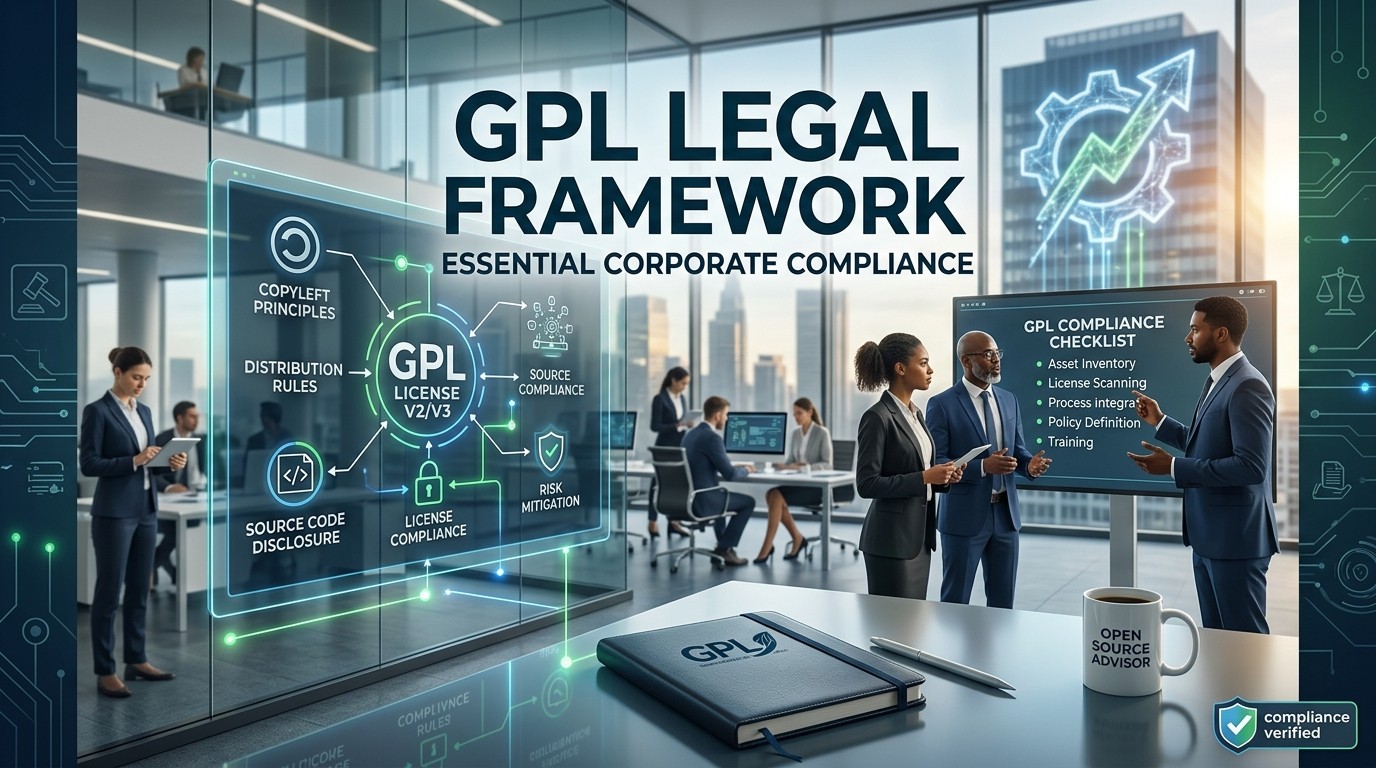
A useful compliance routine starts before code is shipped. First, confirm which files are under the GNU GPL, which parts are internal-only, and which parts are being combined with outside code. Then verify that the repository includes clear notices, that the source archive matches the distributed binary, and that the release notes tell recipients how to obtain the source if needed. The FSF guidance on source notices and distribution is especially helpful here because it emphasizes clarity over guesswork.
A company should also keep a record of version language. If the release is “version 3 only,” it should stay that way; if it is “version 3 or later,” that should be visible in the notice and understood by the team. The FSF specifically explains that unclear wording creates compatibility confusion, so release templates should remove ambiguity before the package goes out.
Finally, tie the checklist to ownership. Someone should know who approves the legal review, who stores the source offer, and who answers questions after launch. GPL Legal Framework becomes manageable when every release has a clear owner, a clear archive, and a clear fallback path if a downstream recipient asks for source.
Conclusion
GPL Legal Framework matters because it turns licensing from a vague risk into a manageable operational system. It explains when source must be shared, how version language affects reuse, why notices should stay attached to the code, and when internal use stays internal. A company that builds these rules into release planning is usually better protected and better organized. GPL Legal Framework is therefore not only a legal topic; it is a product discipline that supports clearer decisions, cleaner launches, and more trustworthy software distribution. In practice, the more a team understands the rules early, the fewer surprises it faces later. For a business that wants stable compliance, that clarity is worth treating as part of the core operating model.
Frequently Asked Questions (FAQ)
1. What does GPL stand for?
GPL stands for General Public License, and the most widespread one is the GNU General Public License. The FSF notes that when people say “GPL,” they usually mean the GNU GPL.
2. Does GPL mean all free software?
No. The FSF says many other free software licenses exist. A license is free software if it grants users the specific freedoms required by the free software definition.
3. Can a company use GPL software internally?
Yes. The FAQ says a company may modify a GPL-covered program and use it internally without ever releasing it outside the organization. The distribution obligation begins when the program is conveyed to others.
4. Must source code be shared when binaries are distributed?
Yes. The FAQ says if binaries are distributed, the corresponding source code must also be provided, and the license text says recipients must receive or be able to get the source code.
5. Is the GPL a noncommercial license?
No. The FAQ says people may sell copies of GPL software and charge fees for downloading it. Commercial activity is allowed; the obligations are about preserving user freedoms and providing source when required.
6. Why should source files carry license notices?
The FSF recommends a copyright notice and license notice in each source file because it reduces confusion and keeps the licensing information attached to the code even if files are separated.
7. What happens if GPL code is linked with other modules?
The FAQ says static or dynamic linking with other modules creates a combined work, and the GPL terms cover the whole combination. That is why integration review matters so much.
8. Is GPLv2 the same as GPLv2-or-later?
No. The FSF explains that version-only and or-later language are different, and that the wording affects compatibility with later GPL versions. Clear version language prevents ambiguity.
9. Does running GPL code on a website require source release?
Not by itself, according to the FAQ. A private modified program used on a website is not the same as distributed software, and the AGPL is the license that changes the network-use rule.
10. Is the FSF’s guidance legal advice?
No. The FAQ says its publications help people understand the GNU licenses, but they are not legal advice, and legal advice must come from a lawyer.