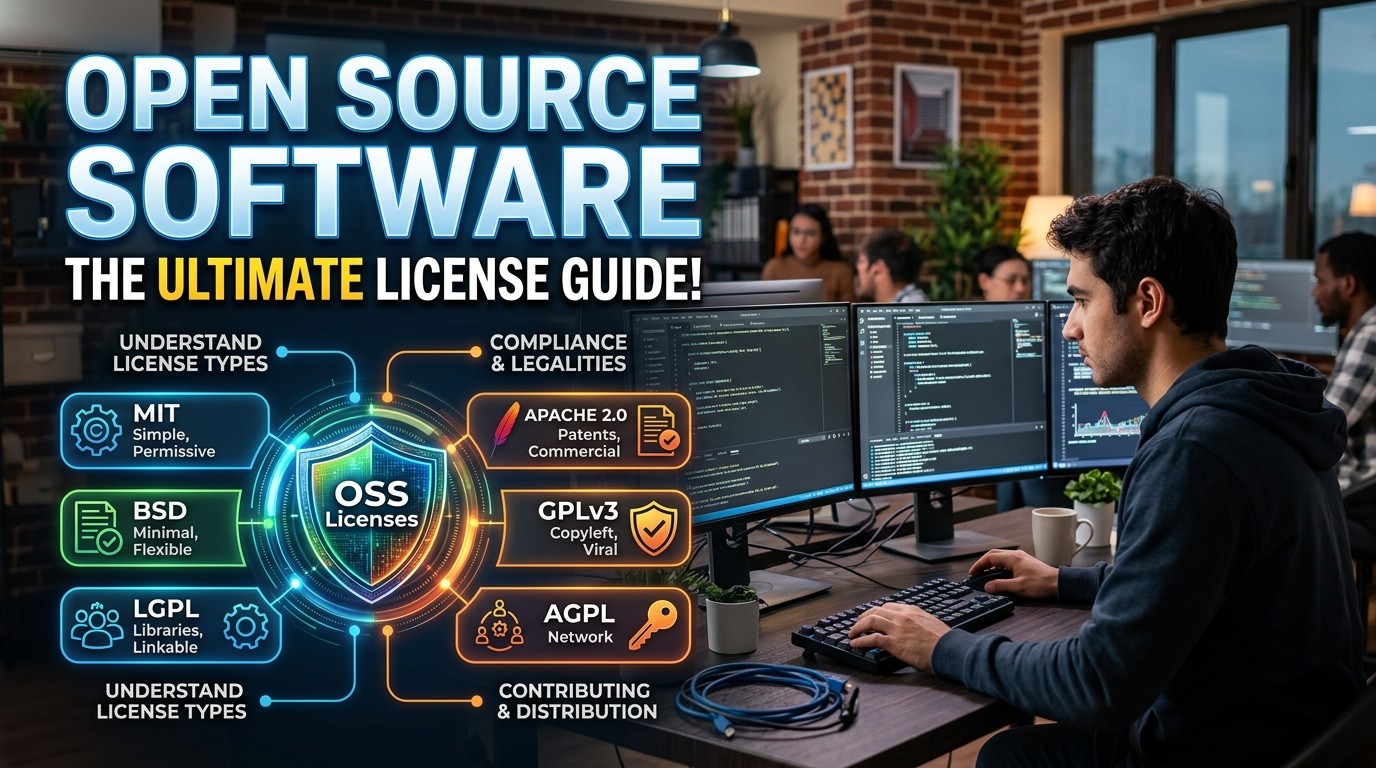
Open Source Software helps teams choose lawful, flexible, and cost-aware tools by understanding licenses, obligations, and practical risks before adoption.
Open Source Software is often chosen for freedom, transparency, and lower upfront cost, but the license is what decides how that freedom actually works in practice. A project may look simple on the surface, yet its legal terms can shape whether you can modify it, redistribute it, embed it in a product, or keep changes private. That is why a license guide matters as much as the code itself.
Many teams first meet Open Source Software through a convenient library, a useful framework, or a tool that solves a painful problem quickly. The instinct is usually to ask whether it is safe, whether it is free, and whether it will save time. Those are valid questions, but the deeper question is what obligations travel with the software after installation.
Open Source Software can be a powerful advantage when the license matches your plan. It can also create expensive misunderstandings when someone assumes “open” means “no rules.” The rules are the point. They are what make the ecosystem sustainable, and they are what protect both creators and users.
The basic idea behind open source licensing
A license is permission. In Open Source Software, that permission is granted in writing, and the writing matters. Without a license, copying or distributing code can create legal risk. With the right license, you can use, study, modify, and sometimes share the software under clear conditions.
Open Source Software is not one single legal model. It is a family of licenses that share a philosophy but differ in important ways. Some are permissive and minimal. Others are protective and conditional. Some allow almost any use with attribution. Others require you to share derivative work under the same terms.
That difference is critical for developers, product teams, and agencies. A tool that works beautifully in a prototype may become complicated when it moves into a commercial release. Open Source Software deserves review before integration, not after shipping.
Why businesses care about license choice
Open Source Software saves money only when the organization understands the license obligations attached to it. The wrong assumption can turn a free component into a compliance headache. That is why legal and technical teams should review the same project together.
For startups, Open Source Software can accelerate product development and reduce vendor lock-in. For larger organizations, it can support standardization, security audits, and long-term maintainability. But every benefit depends on the business model. If your product strategy includes redistribution, SaaS, embedded firmware, or client delivery, the license decision becomes even more important.
Teams often focus on features first, then licensing second. The better order is the opposite. First confirm whether the license fits the intended use, then evaluate performance, popularity, and ecosystem support. Open Source Software is strongest when the legal path is clear from day one.
Permissive versus copyleft

One of the most important distinctions in Open Source Software is between permissive and copyleft licenses. Permissive licenses are generally simpler. They allow broad use, modification, and redistribution with relatively light obligations, usually centered on attribution and disclaimer retention.
Copyleft licenses are different. They allow use and modification too, but if you distribute derivative work, you may need to share the source under the same license. This is a deliberate design choice intended to preserve openness downstream. For some teams, that is a feature. For others, it is a constraint.
Open Source Software users should not treat these categories as good and bad. They are different tools for different goals. A permissive license may suit a commercial library you want to embed quietly. A copyleft license may suit a community project that wants improvements to remain available to everyone.
What to check before adopting a project
Before you adopt Open Source Software, review the license text, the version number, the repository history, the contributor model, and whether the project has clear maintainers. A project with no active stewardship may create more risk than value even if its license looks friendly.
You should also check whether the license applies to the whole project or only to specific parts. Some repositories mix code, documentation, fonts, images, templates, and examples under different terms. Open Source Software decisions become safer when you map the license boundary carefully.
Another important question is whether the code has dependencies of its own. You may choose one package only to discover that its dependency chain brings in a stricter obligation. A clean review of the whole stack is much better than relying on the top-level project name alone.
The practical side of compliance
Compliance does not need to be scary. It needs to be organized. Keep a record of the software you use, its version, its license, the source repository, and any notices or attribution files. Open Source Software becomes manageable when inventory is part of the process instead of an afterthought.
That is especially true for teams shipping commercial products. A release checklist can include license review, notice file updates, source distribution requirements, and documentation of modifications. If everyone knows what to collect before release, the process becomes routine rather than stressful.
Open Source Software compliance is not only for legal teams. Developers, product managers, and DevOps staff all play a role. If code is added, changed, packaged, or redistributed, someone should know how licensing is affected.
A simple comparison table
| License style | Typical traits | Common fit |
|---|---|---|
| Permissive | broad use, light obligations | apps, services, libraries |
| Weak copyleft | shared improvements in limited areas | mixed projects |
| Strong copyleft | derivative work must remain open | community releases, shared ecosystems |
| Custom or unclear | special terms or missing clarity | high-risk until reviewed |
This table is only a starting point, but it helps teams talk about Open Source Software without getting lost in legal jargon. The goal is not to memorize every clause. The goal is to know what kind of obligations you are accepting.
The importance of attribution and notices
Many people assume attribution is a small detail. In practice, it is one of the most common obligations in Open Source Software. You may need to preserve copyright notices, license texts, or author acknowledgments in source or distribution materials.
That requirement is usually manageable, but it must be handled consistently. If your release process strips notices from packages, you may unintentionally violate the license. Open Source Software works best when attribution is treated as part of good engineering hygiene.
A simple habit is to include a third-party notices file in your product or repository. That file can collect the relevant license text and keep your records clean. Once that becomes standard practice, compliance becomes much easier.
How derivative work changes the conversation
A major legal question in Open Source Software is whether your modifications create derivative work and what that means for distribution. The answer depends on the license and the nature of the changes. Simply using software internally is not the same as distributing a product based on it.
If you modify an open source component and ship it to customers, you may trigger obligations that do not apply to private internal use. Open Source Software therefore requires a mindset that separates development convenience from distribution consequences.
This matters for plugin ecosystems, SDKs, desktop applications, embedded devices, and shared infrastructure. A team may believe it is “just using” a package, while legally it is creating a combined work or a distributed derivative. That is why careful review is essential.
Why community quality matters
A healthy project is easier to trust. In Open Source Software, legal clarity and community clarity often go together. Active maintainers, well-written documentation, issue tracking, security response, and versioned releases all indicate a mature project.
A stagnant repository may still be useful, but it increases risk. If bugs remain unresolved and no one is answering questions, the software can become expensive to support. Open Source Software is not only about code access. It is about long-term maintainability.
This is also where reputation matters. A widely used project with clear governance often has more predictable behavior than a niche tool with unclear ownership. In practical terms, support quality influences the true cost of adoption.
The hidden cost of free software

Open Source Software is free to obtain, but not free to operate. You still pay in engineering time, maintenance, testing, training, and integration. If the project is unstable, that hidden cost can be significant.
A tool that looks cheaper than a commercial alternative may cost more in the long run if your team must patch it, document it, or maintain it themselves. Open Source Software should be evaluated on total cost of ownership, not only on license price.
That does not make open source less valuable. It makes the value more honest. The best decisions happen when organizations understand that “free” means no upfront license fee, not zero cost.
When internal use changes the risk profile
Many organizations use Open Source Software internally with little concern because the software never leaves the company. Internal use is often simpler than distribution, but it is still wise to keep records and understand future plans.
A project that begins as internal tooling can later become customer-facing. At that point, the license question changes. Open Source Software that was harmless in an internal dashboard may need review when embedded in a public product.
That is why teams should think ahead. If there is any chance the software will move from internal use to external release, document the license decision early. Future you will appreciate the clarity.
Security and license review should happen together
Security reviews often happen separately from licensing review, but they should inform each other. Open Source Software can introduce both technical and legal risk if the project is old, unmaintained, or poorly documented.
A package with a permissive license may still be unsafe if it has known vulnerabilities or a weak dependency chain. Likewise, a highly secure project may be a poor legal fit if the license conflicts with your business model. The best process reviews both at once.
Open Source Software due diligence should include vulnerability scanning, dependency checks, version pinning, and license inventory. That combination gives a fuller picture of what you are actually adopting.
Special note on plugins and site tools
A lot of teams first encounter Open Source Software in web projects, content platforms, and add-ons. A plugin may be tiny, but it can still create meaningful obligations if it is redistributed with a product or bundled into a client site.
For example, a Responsive SEO FAQ Plugin can seem like a simple convenience layer, yet the licensing terms still matter if you customize, bundle, or resell it. Open Source Software is especially important in plugin ecosystems because many small components combine into a larger delivery.
The same logic applies to a Local SEO for WordPress Plugin. It may be easy to install and useful for clients, but your obligations depend on the actual license, the notices included, and how the code is distributed.
Why version numbers matter
Two projects with the same name may have different license versions. That is a serious detail. Open Source Software often evolves through versioned legal language, and those changes can alter what you may do with the code.
If a project upgrades its license, the new version may be more permissive, more restrictive, or simply clearer. Either way, your legal position depends on the version you actually use. Open Source Software decisions should therefore record not only the name but also the license version and the software version together.
This is especially important when building long-lived products. A component you adopt today may remain in your product for years. If the upstream license changes later, you need historical records to know which terms apply to which release.
The role of documentation
Good documentation makes Open Source Software easier to trust and easier to govern. Clear install instructions, change logs, contribution guidelines, and licensing notes all reduce uncertainty.
When documentation is missing, teams often guess. Guessing is dangerous. A package may function well, but if nobody can explain how to comply, maintain, or update it, the risk rises. Open Source Software is strongest when code and documentation move together.
You should also document your own usage. If you modify an upstream project, note what changed, when it changed, and why. GNU GPL License That record helps with compliance, debugging, and PDF tools like GPL Ghost Script.
Practical tips for teams
Keep an inventory of everything you use. Review dependencies regularly. Preserve notices. Store the license text with your release materials. Make sure someone owns the process. Open Source Software becomes much safer when these habits are part of everyday work.
For product teams, create a clear intake process for new dependencies. Before adding a package, ask what it does, who maintains it, and what license it uses. Open Source Software should be approved intentionally, not borrowed impulsively.
For agencies and freelancers, the lesson is similar. If you deliver client work that includes third-party code, know whether you can include it at all, and whether the client must keep notices or source code available. Open Source Software is not just a technical choice; it is a delivery choice.
Why open source still wins so often

Even with legal care, Open Source Software often delivers huge advantages. Transparency makes auditing easier. Community contributions improve quality. Avoiding vendor lock-in keeps options open. Teams can learn from the code instead of treating it as a black box.
Those advantages explain why open source remains central to modern software development. The point of a license guide is not to discourage adoption. It is to make adoption smarter. Open Source Software works best when its freedom is matched with attention.
When teams understand the rules, they can move faster with confidence. They can choose better dependencies, avoid avoidable conflict, and build products that last. That is why licensing knowledge is not a side topic. It is part of technical maturity.
Where legal caution is worth the effort
If you are shipping software to customers, bundling components into a product, or supporting a large codebase, legal review is worth the time. Small mistakes multiply fast. Open Source Software can be a gift, but only if the obligations fit your use case.
If you are only experimenting locally, the pressure is lower, but the habit of checking still helps. A team that learns good license discipline early will make fewer mistakes later. Open Source Software is easier to manage when review is normal rather than exceptional.
The goal is steady confidence. You do not need to fear every license. You need a repeatable process that tells you which projects are safe, which need attention, and which should be avoided.
Conclusion
The best approach is simple: choose with intention. Use software because it solves a real problem and because the license allows the use you need. Open Source Software is most valuable when legal clarity, technical quality, and business goals line up.
If that alignment is missing, the “free” tool may become expensive later. If the alignment is strong, the result can be excellent: flexible, transparent, and durable software that supports your work without trapping it. That is the real promise of open source.
Conclusion: Open Source Software gives teams freedom, but that freedom only becomes useful when the license matches the intended use. Permissive and copyleft terms serve different goals, so the right choice depends on whether you plan to distribute, modify, embed, or simply use the code internally. Strong compliance habits, clear documentation, dependency review, and version tracking make adoption much safer. When the license is understood early, open source becomes a real advantage instead of a hidden risk. The smartest teams do not just ask whether the code is good; they ask whether the license supports the future they want to build.
1. What does the term mean?
Open Source Software refers to software whose source code is made available under a license that allows users to use, study, modify, and often redistribute it under defined conditions.
2. Is open source always free?
Open Source Software usually has no upfront license fee, but it still has costs in maintenance, integration, support, and compliance.
3. What is the difference between permissive and copyleft licenses?
Permissive Open Source Software licenses are generally more flexible, while copyleft licenses may require derivative work to remain under the same terms.
4. Do I need to keep notices?
In many cases, yes. Open Source Software licenses often require you to preserve copyright notices, attribution, or license text in your distribution materials.
5. Can I use open source in commercial products?
Often yes, but it depends on the license. Open Source Software must be checked carefully before commercial adoption, especially if you plan to distribute the product.
6. Why do dependencies matter?
Your main package may be fine, but its dependencies can carry different obligations. Open Source Software review should include the whole dependency chain, not just the top-level project.
7. Is internal use safer than distribution?
Usually, internal use is simpler because many obligations are triggered by distribution. Still, Open Source Software should be documented early in case the project later becomes customer-facing.
8. How do I manage compliance?
Keep an inventory of software, record license versions, preserve notices, and review releases before shipping. Open Source Software compliance works best when it is part of the normal workflow.
9. Why do license versions matter?
Different versions can change obligations or permissions. With Open Source Software, you should record both the software version and the license version to avoid confusion later.
10. When should I ask for legal review?
Ask before distribution, bundling, or any product launch that includes third-party code. Open Source Software is easiest to handle when legal review happens early, not after release.